

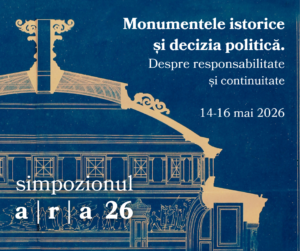
ARA Association, in collaboration with Vasile Pârvan Institute of Archaeology and The Bucharest Municipality Museum, invites researchers to the annual “Architecture. Restoration. Archaeology” Symposium and roundtable discussion with the title: Historic Monuments and Political Decision-Making. On Responsibility and Continuity
 For its 26th edition, we invite researchers to participate with scientific communications in the spirit of this year’s theme, inspired by Archaeology, Restoration, the History of Architecture or Art. Please submit an abstract in English or Romanian of no more than 300 words to the following e-mail addresses: contact@simpara.ro or margineanu_monica@yahoo.fr, by 22 March 2026.
The three-day symposium will be held on 14-16 May 2026 at the George Severeanu Museum, Henri Coandă St. no 26.
____
This year’s ARA Symposium proposes an essential reflection on the relationship between historic monuments, the legislative framework that governs them, and the political decisions that ultimately determine their fate.
Although the legal provisions for the protection of historic monuments are coherent and well articulated, their implementation remains vulnerable to short-term pressures and shifting priorities. In recent years, an increasingly visible tendency has emerged to treat historic monuments — and cultural heritage in general — as secondary concerns when confronted with immediate development imperatives.
At the same time, public discourse on heritage appears to have undergone a gradual erosion: frequently invoked at declarative level, it is far less consistently supported by coherent and principled decisions. In such a climate, historic monuments risk being reduced to negotiable constraints or symbolic instruments, rather than recognised as fundamental markers of collective memory and continuity.
The proposed theme calls for a lucid examination of the extent to which professional expertise is integrated into or marginalised from decision-making processes. Historic monuments are not merely objects of conservation; they are material expressions of responsibility extending beyond political cycles and economic contingencies.
At a time when their status appears increasingly subject to relativisation, a clear and unequivocal reaffirmation of the principles underlying their protection becomes necessary — not as rhetorical posture, but as institutional and professional commitment.
The protection of historic monuments is not one cultural option among others. It reflects the level of maturity of a society. The ARA Symposium assumes this reflection — and this responsibility.